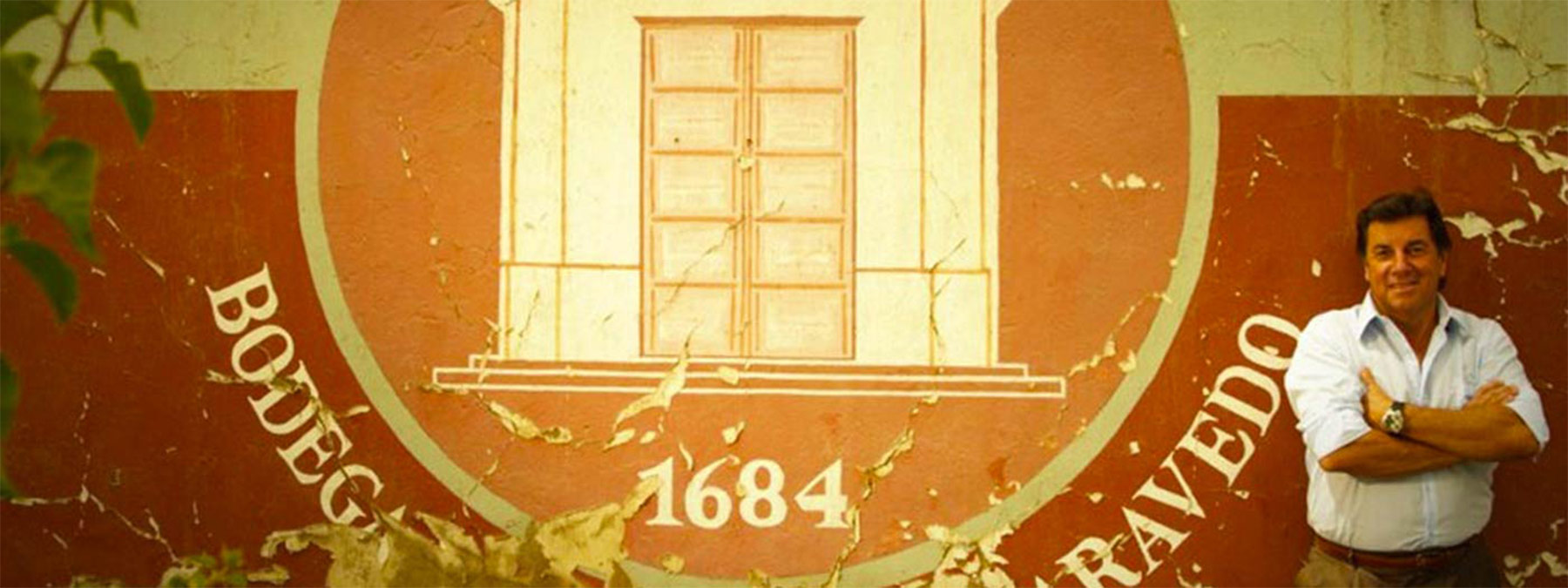
Pisco Portón has been produced since 1684 in the Hacienda La Caravedo in Ica (Peru) where the oldest working distillery in America is located. Here traditional methods are maintained for the preparation of the distillate without the use of electricity or modern machinery. The pressing of the grapes is entrusted to large wooden presses and the channels use natural gravity to convey the liquid from one phase of the processing to another.
The varieties of grapes used are divided into two main groups: aromatic and non-aromatic.
Of the first group, aromatics, are the varieties of Italia, Moscatel, Albilla and Torontel.
In the range of non-aromatics there are Negra Criolla, Mollar, Uvina and Quebranta, the latter being the most widespread in the Ica valley.
Master Johny Schuler uses three different processing methods for each reference. For Green Must it proceeds to the discontinuous distillation without the must having completed the fermentation. Quebranta is the Single Malt of the Pisco for which only the homonymous variety is used. Acholado is a blend of aromatic and non-aromatic varieties.
There are no other ingredients or additives added and no aging is expected for the final product. Around the distillery a garden was replenished in order to absorb the carbon dioxide naturally produced by fermentation and a water recovery system was made along the vineyards.
Distillates have different alcoholpercentages. So, we have defined a parameter allowing you to better understand and compare different prices. This parameter is calculated by dividing the bottle price by the alcohol content. The alcohol content (or strength) is the amount of pure alcohol (ethanol) contained in the distillate.
This parameter indicates the price of a single 4cl dosage of distillate. It is calculated by dividing the price of the bottle by its quantity (expressed in cl), then multiplying by the centilitres of the recommended single dose, as average in cocktail recipes.