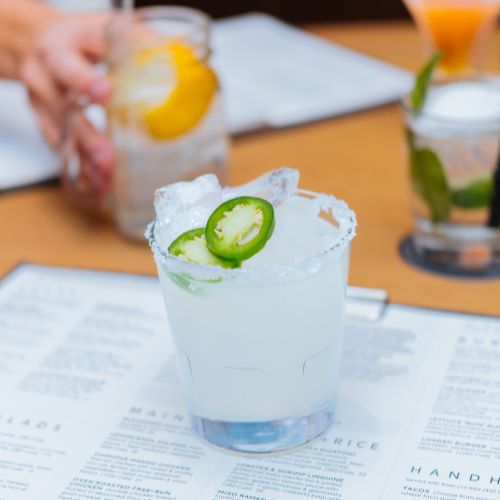
The date of birth of this iconic cocktail is uncertain, however, it is almost certain that it was not born as we know it today, i.e. shaken in the shaker and served in a small cup: mining engineer Jenning Cox proposed it in the form of a Punch to share with his guests, so it was almost certainly born by accident or force majeure. Legend has it that Cox and his guests, who usually drank Gin Punch, one day ran out of gin, and had to adapt the recipe with the first distillate readily available in the Cuban hinterland where they worked, namely rum, or more likely a homemade aguardiente, who knows, maybe even pure cane juice.
Again according to legend, it was a guest of engineer Cox, his colleague Francesco D. Pagliuchi, who named it Daiquirì, taking inspiration from the Daiquiri location where the two were at the time of the creation of this drink, initially called Rum Sour.
As with so many historical rum cocktails, the inspiration comes from traditional drinks, and it is quite evident that the daiquiri is a child of the much older canchanchara.
One thing is for sure, to make an excellent daiquiri you have to go back through the history of rum to get to the origins of the original taste of this cocktail. When it was invented, in fact, even the high-sounding names of Ron Cubano were much more complex than today: those who have had the good fortune to taste some of them tell of a great resemblance to today's agricultural rums, very rich in the aromas coming from the transformation of sugar cane, and above all the result of artisanal distillation, whether discontinuous or continuous.
Daiquiri is composed of only three ingredients, and their choice will determine the final result in a very important way:

The lime. Don't jump through hoops unless you find a perfectly ripe and intact lime, possibly untreated and with a rind rich in essential oils: if you don't find a good lime, simply don't use it! Rather rely on your greengrocer and choose a local product: it may be less exotic than the lime, but at least it will be fresh and intact. Clearly what makes a Daiquiri special is also the aromatic component of the lime, so use it preferably, as long as it is good. Squeeze the lime at the moment and use it straight away: don't leave it to wait, as every minute will compromise the aromatic part and bring down the acidity.
Sugar. You can make a syrup to make the mixing easier: dissolve 2 parts sugar in 1 part water, bring to the boil, as soon as you see the first boil turn it off, let it cool and store it in the fridge. Use only cane sugar, and if you don't want to make the syrup yourself, you can buy very good ones, as long as they are made from cane sugar.
Some say that beet sugar is better: it is certainly less intrusive aromatically, but what sugar would engineer Cox have used in Cuba in the late 1800s?
50 ml Veritas Blended Rum
5 ml lime juice
15 ml sugar syrup
Pour the ingredients into the shaker.
Shake for a few seconds.
Strain by pouring the cocktail into a chilled glass.
The Daiquiri with Veritas Rum is the closest to the original version: the flavour profile of this blended rum is in fact very similar to the old Bacardi or Havana Club of the early 1900s.
Veritas is a blend of an unaged rum, a Pot Still aged two years at Foursquare and another aged at Hampden Estate.
45 ml Clairin Sonson
25 ml fresh lime juice
15 ml sugar syrup
Pour the ingredients into the shaker.
Shake for a few seconds.
Strain by pouring the cocktail into a chilled glass.
This is a Daiquiri for the most experienced palates, perhaps the most 'gourmet'. Clairin is an ancestral distillate produced today using the same method as 200 years ago, the result of natural farming and absolutely spontaneous fermentation of cane juice. The discontinuous distillation concentrates all the aromas, making the Daiquiri very complex: we could call it 'gourmet', not a simple drinking cocktail.
40 ml River Antoine rum
25 ml fresh lime juice
15 ml sugar syrup
Pour the ingredients into the shaker.
Shake for a few seconds.
Strain by pouring the cocktail into a chilled glass.
The aromatic intensity of Rivers allows you to significantly lower the dosage at the base of the Daiquiri but, thanks to the alcohol content and all the volatile non-alcoholic components that make it up, you can use less while maintaining the same dosage of lime and sugar as in the other recipes. Rivers basically has a greater ice melting capacity, so your Daiquiri will always be perfect.

Distillates have different alcoholpercentages. So, we have defined a parameter allowing you to better understand and compare different prices. This parameter is calculated by dividing the bottle price by the alcohol content. The alcohol content (or strength) is the amount of pure alcohol (ethanol) contained in the distillate.
This parameter indicates the price of a single 4cl dosage of distillate. It is calculated by dividing the price of the bottle by its quantity (expressed in cl), then multiplying by the centilitres of the recommended single dose, as average in cocktail recipes.