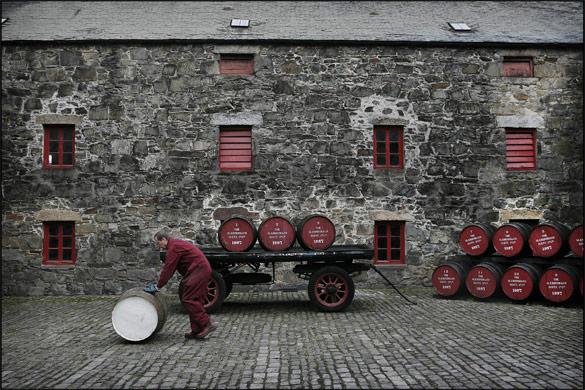
Founded in 1826 by a consortium of farmers led by John Allardice, GlendDonach is a historic distillery in the Eastern Highlands of Scotland, in a valley near Forgue, and is now one of the best known brands in the world of single malt. Changed hands over the decades, its modern history began in 1960, when it was bought by the William Teacher & Sons group, which established its identity as a single malt with a strong Sherry feel. After a period of closure, from 1996 to 2002, the great turning point came: the great whisky maker Billy Walker bought the distillery, relying heavily on the great heritage of European oak casks in the warehouse.
GlenDronach's style is unique in the Scotch whisky world: its low production of just over a million litres a year makes it a semi-industrial distillery with a strictly traditional approach. One of the last distilleries to abandon the malting floor and direct fire feeding of the four stills, it still has three of the six dunnage-style cellars, where the casks rest horizontally on rammed earth floors and are arranged in just three rows. The greatness of this distillery lies in the high quality of the casks owned by GlenDronach.

Extreme attention to ageing processes and wood has characterised the last decades of GlenDronach's history. In the ageing cellars, the vast majority of barrels are Spanish oak, as the distillery selects the best ex-Oloroso and ex-Pedro Ximenez barrels.
This type of ageing is becoming less and less common in the world of Scotch, given the high cost of supply and the scarcity of barrels that have actually contained Sherry wine for years.
So the Sherry imprint, on which the entire range of official bottlings is based, has made GlenDronach the favourite brand of those who enjoy this type of ageing.

It goes without saying that in order to subject a distillate to long ageing in barrels of personality such as the ex-Sherry barrels, it is necessary to start with a spirit with broad shoulders, capable of dialoguing on an equal footing with wood. So the fermentations are long, from 60 to 96 hours, in order to obtain a must that is already rich.
Above all, the four stills in operation at GlenDronach are low, squat and with a descending neck, all elements that reduce reflux during distillation and help to extract a 'dense' new make spirit with robust malty notes. By the way, until 2005 the stills were fired by direct fire, a method of production that made the whisky even more full-bodied, and so today many GlenDronach single malts still contain spirit distilled in the traditional way.

The GlenDronach's historic range starts with the 12 year old Original and, through the resurrected 15 Revival and 18 Allardice, goes on to the sumptuous 21 year old Parliament. All whiskies come from European oak casks that have contained Sherry Oloroso or Pedro Ximenez, fortified wines that give deep notes of red and black fruits, nuts and chocolate.
Recently, however, the distillery has also introduced a whisky that combines the vinous notes of sherry with the soft, fresh scents of American oak: The Hielan ages 8 years and is created from a mix of ex-Bourbon and ex-Sherry casks.
Finally, few people know that until 1996, when the traditional malting floor was discontinued, the barley malted in the house was slightly peaty, at 14 ppm. And so, in homage to this recent past, GlenDronach Peated and Port Peated were born, captivating whiskies that combine the strong malt notes of the Forgue distillery with a sweet, unobtrusive but very recognisable peatiness.
Distillates have different alcoholpercentages. So, we have defined a parameter allowing you to better understand and compare different prices. This parameter is calculated by dividing the bottle price by the alcohol content. The alcohol content (or strength) is the amount of pure alcohol (ethanol) contained in the distillate.
This parameter indicates the price of a single 4cl dosage of distillate. It is calculated by dividing the price of the bottle by its quantity (expressed in cl), then multiplying by the centilitres of the recommended single dose, as average in cocktail recipes.