Acapulco, 1963. In the famous film Fun in Acapulco, Elvis Presley sips Margaritas while filming several scenes, but it was mainly behind the scenes, it seems, that he enjoyed this cocktail the most. How can you blame him, after all, given the beauty of the locations in which they were filmed, which encouraged people to enjoy life?
But who invented the Margarita? Was it an anonymous "cantinero" from a posada in Puerto Vallarta, a distinguished barman from a hotel in Acapulco or an unknown Californian bartender? Let's take a step back to the 1940s.
The alleged inventors of the Margarita are many, starting with Carlos "Danny" Herrera, a Tijuana restaurateur, who has always claimed to have created the cocktail first, expressly for Marjorie King, a former actress, frequenter of the American jet set and widow of the New York playboy Phil Plant. According to Herrera, the cocktail was created in his 'Rancho La Gloria' during a party to please Marjorie, who was allergic to all alcoholic beverages except tequila. The name Margarita (Spanish for Marjorie) is said to have been a tribute to her. The story, it has to be said, does not quite add up, as Marjorie King should not have been allergic to Triple Sec as well.
The second version features Margaret Sames, a Texan lady who often entertained famous guests in her Acapulco villa. At one of these receptions, the hostess is said to have given advice on a cocktail of tequila, Triple Sec and lime juice to Johnny Durlesser, the famous Californian bartender at Tail o' the Cock: a drink he would call Margarita, as his Mexican friends called it. A few years later, when the Margarita began to be one of the most popular cocktails in the United States, Durlesser claimed to be the inventor of the recipe, and also to have won a prize in a national bartending competition - which was never officially confirmed. In response, Margaret Sames indignantly declared to the press that she was the creator, and called Durlesser a liar.
The mystery of the origins of the Margarita is destined to remain unsolved.

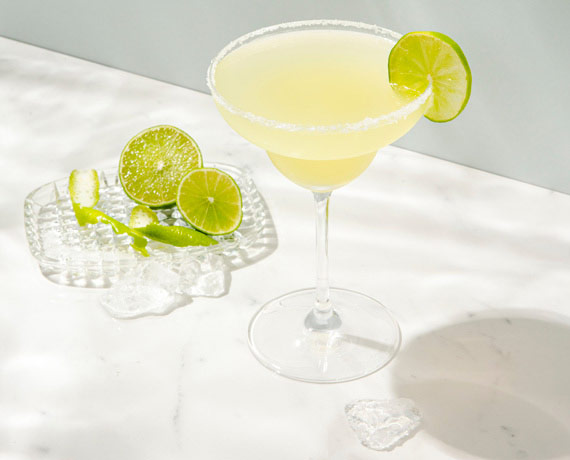
5 cl Fortaleza Blanco Tequila 100% agave
3 cl Monin Triple Sec Curaçao
1,5 cl Fresh lime juice
Shake with ice and pour into a cocktail glass with only half the rim of salt.
This is the historic Margarita, known since the 1940s, and still one of the most popular cocktails in the world: in the United States alone, 200,000 are consumed every hour.
5 cl Tapatio Blanco Tequila 100% agave
1,5 cl Fresh lime juice
1 cl (2 bar spoon) Herradura agave syrup
Pour all ingredients into a shaker with ice, shake and strain into a chilled cocktail glass. It can also be prepared in an on-the-rocks version: instead of straining into a glass, strain directly into a rock glass filled with ice. A salt rim is not recommended here.
This version was created by Julio Bermejo at Tommy's Restaurant in San Francisco in the late 1980s.
5 cl Rooster Rojo Blanco Tequila 100% agave
3 cl Original Blue Curaçao Senior
1,5 cl Fresh lime juice
Shake with ice and pour into a cocktail glass with only half the rim of salt.
It became popular in the 1970s on cruise ships plying the Caribbean Sea, and gained fame in the US, especially in its frozen version, thanks to chain establishments such as T.G.I. Friday's, Chili's, Ruby Tuesday and Applebee's. For this reason it was better known as the 'New York Margarita'.
N.B. The Margarita is a cocktail for dreamers, the distracted, the busy and the distant, as well as travellers, holidaymakers, jugglers, tightrope walkers
and those who live in clouds - that's right, not in a cloud, in real clouds.

Distillates have different alcoholpercentages. So, we have defined a parameter allowing you to better understand and compare different prices. This parameter is calculated by dividing the bottle price by the alcohol content. The alcohol content (or strength) is the amount of pure alcohol (ethanol) contained in the distillate.
This parameter indicates the price of a single 4cl dosage of distillate. It is calculated by dividing the price of the bottle by its quantity (expressed in cl), then multiplying by the centilitres of the recommended single dose, as average in cocktail recipes.